

Lumagen Video Processors
Lumagen has been a trusted name in video processing for over two decades, and their Radiance Pro line remains a go-to choice for serious home theater enthusiasts. The Radiance Pro sits in your signal chain between source devices and your projector or display, applying sophisticated video processing that dramatically improves image quality — including dynamic tone mapping, precision upscaling, and display optimization that brings out the best in your projector.
Products
Below is a selection of Lumagen’s video processors — from the next-generation ArtisaN 8K to the proven RadiancePro series. The RadiancePro is available in multiple configurations (4140, 4240, 4242, 4244, 4246, 4444, 4446, 5244, 5348) — contact us to find the right model for your system.
ArtisaN 8K READY
Next-generation flagship video processor. 8 HDMI inputs, 2 outputs, 12-bit 4:4:4 processing pipeline. Features Dynamic Tone Mapping, NoRing scaling, Darbee Visual Presence up to 4K60, and 3ms game mode. Upgradeable to HDMI 2.1 with full 8K and 4K120 processing. 2U rack-mountable.
RadiancePro 5348
Top-of-the-line Radiance Pro with ultra-low HDMI output jitter. 10 inputs (all 18 Gbps), 2 video outputs plus 1 audio-only output. Ideal for placement before audio processors to enhance signal clarity. 12-bit 4:2:2 processing with DTM, true genlock, and NoRing scaling. 1U rack-mountable.
RadiancePro 4446
Maximum I/O in the standard Radiance Pro tier. 8 inputs, 4 outputs with picture-in-picture and picture-on-picture support. Same core video processing as the entire lineup — DTM, true genlock, Darbee, and NoRing scaling. 1U rack-mountable.
About
What makes the Radiance Pro special is its combination of proven, reliable processing with deep calibration capabilities. DTM (Dynamic Tone Mapping) for HDR content adapts on a frame-by-frame basis, preserving both highlight detail and shadow depth. The built-in CMS (Color Management System) allows ISF-grade calibration stored directly in the processor, and the NLS (Non-Linear Stretch) feature elegantly handles aspect ratio mismatches without the distortion of simple zoom or stretch modes.
TekScene installs and configures Lumagen Radiance Pro processors across the Columbia, SC metro area. These are sophisticated devices that require careful setup — EDID management, input configuration, DTM tuning, and display settings all need professional attention to get right. We ensure your Lumagen is configured to deliver the full picture quality improvement it's capable of, matched to your specific projector and screen combination. We serve the greater Columbia area — Chapin, Lexington, Irmo, West Columbia, and Lake Murray.
Where Lumagen Puts Its Effort
Every video processor tone maps and scales. What distinguishes one from another is the rest of the job — frame timing, calibration depth, aspect ratio handling, and how well it behaves as the hub of a real system.
True genlock
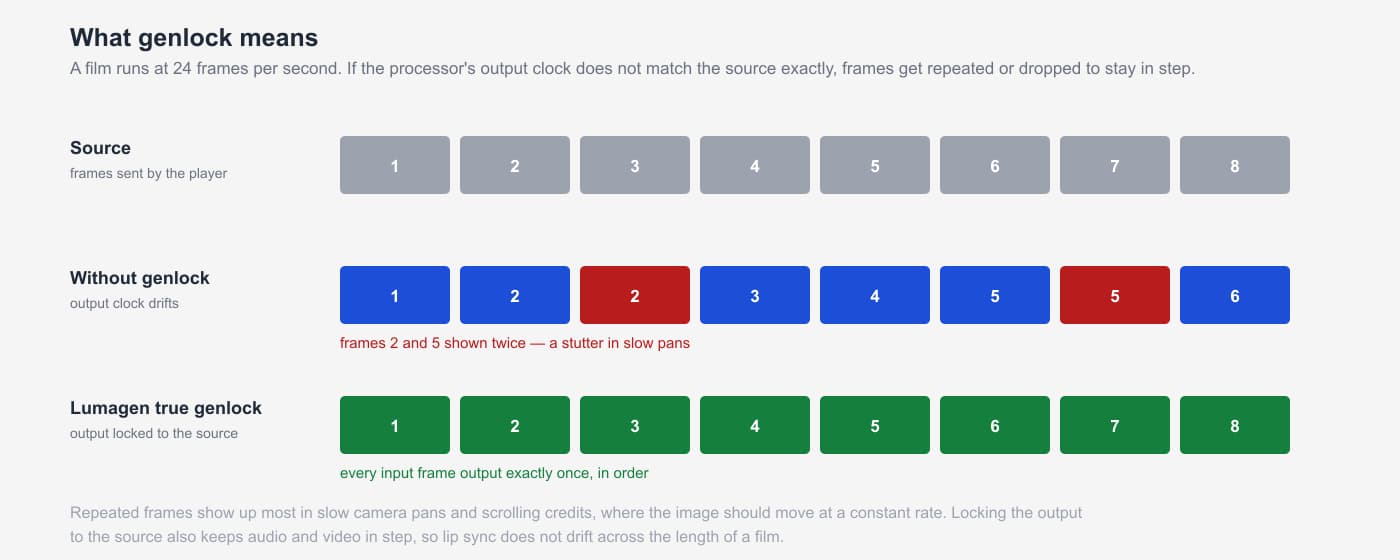
This is Lumagen's signature, and it is the least marketed of their strengths because it is invisible when it works. A film runs at 24 frames per second. If a processor's output clock does not exactly match the incoming source, frames have to be repeated or dropped to keep the two in step.
Lumagen locks the output to the source so that each input frame is output exactly once, in order. Nothing is repeated and nothing is dropped. You notice it most in the places where any irregularity shows: slow camera pans, scrolling credits, anything that should move at a perfectly constant rate.
The same locking keeps audio and video in step, which is why Lumagen also provide programmable video delay to compensate for processors that add significant audio latency.
Aspect ratio and masking — across the whole line
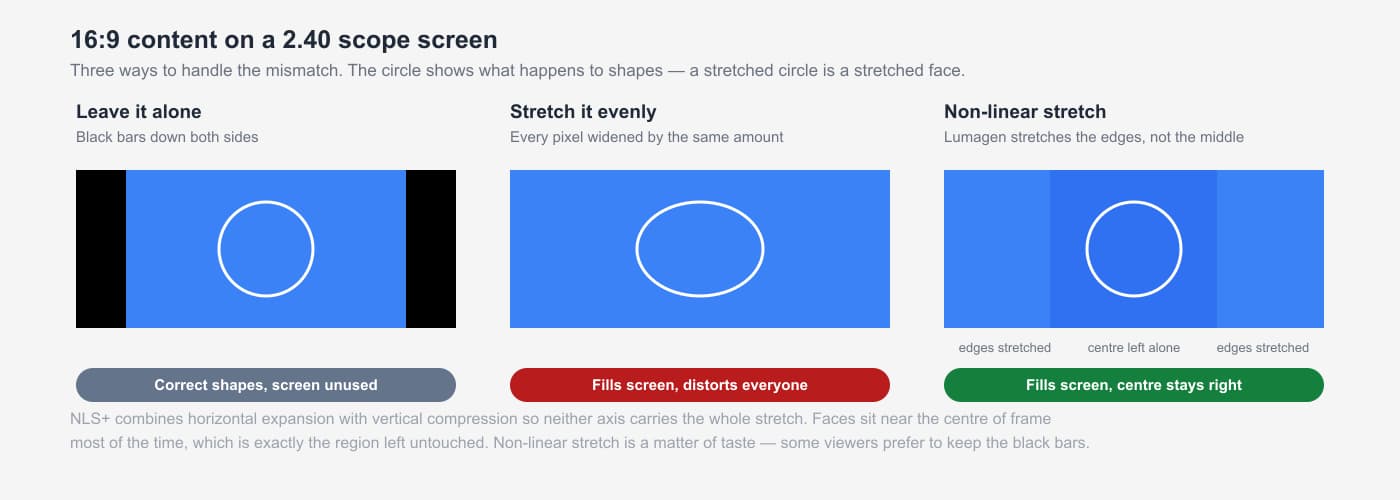
This is on every Lumagen, not reserved for the flagship, and it is the feature owners end up using every day. The processor detects the source aspect ratio instantly and sets the right output aspect, size and masking to match — so changing from a scope film to a 16:9 broadcast needs nothing from you.
It drives Stewart Filmscreen and Seymour Screen Excellence masking systems directly, so the screen borders move with the content. It supports anamorphic screens with or without an anamorphic lens. And it offers non-linear stretch, which fills a scope screen with 16:9 content by stretching the edges while leaving the center close to correct, rather than distorting the whole frame evenly.
Non-linear stretch divides opinion — plenty of people would rather keep the black bars and see the frame as shot. It is entirely optional, and adjustable in how far it goes.
Calibration held in the processor
Lumagen's heritage is calibration, and the hardware reflects it. A 4913-point 3D LUT — a 17x17x17 cube, 21³ on some configurations — sits alongside 21-point parametric grayscale control, stored in the processor itself rather than in the display.
That location matters more than the point count. Correcting in the processor is far more precise than most projectors' internal picture controls allow, and the correction stays with the signal chain rather than living in a display's menus, so a calibrator can work to a reference standard without being limited by whatever adjustments your particular projector happens to offer.
For context, a madVR Envy carries a much larger 3D LUT — 256³, roughly 16.7 million points. Whether that resolution is visible in a finished calibration is a question for your calibrator, but if maximum calibration depth is the priority it is worth knowing which box holds more of it.
Lumagen also desaturates Rec 2020 content for displays that only cover Rec 709 or P3, which is most projectors — showing wide-gamut content correctly on a display that cannot reach the whole gamut is its own problem, and an easy one to get wrong.
Built to be the hub
A Radiance Pro or ArtisaN is a switcher as much as a processor. Configurations run from 2 to 10 inputs, with models offering a dedicated audio-only output so video can go straight to the display while audio takes a separate path to your processor.
It reads Kaleidescape's Costar and content-type metadata, integrates with theater control systems, and rack mounts — 1U for Radiance Pro, 2U for the ArtisaN.
Lumagen also pay attention to the electrical side — low output jitter and low radiated interference, measured with Tektronix instrumentation, on the grounds that a noisy HDMI output does no favors to the audio equipment sharing a rack with it.
A 4:4:4 pipeline on the ArtisaN
The ArtisaN processes at 12-bit 4:4:4 — full chroma resolution, a color sample for every pixel — where the Radiance Pro line runs 12-bit 4:2:2. If the terms are unfamiliar, the chroma sampling diagram on our Kaleidescape page shows exactly what the difference looks like. Since almost all source material arrives at 4:2:0 or 4:2:2, the benefit is not in the source but in the processing: tone mapping, scaling and color correction all involve arithmetic on color values, and doing that work at full chroma resolution avoids compounding the losses already present in the source.
It matters most where the processor is doing the most work — heavy tone mapping on HDR, upscaling older material, or a 3D LUT applying substantial color correction. On a large screen those are exactly the situations where chroma errors become visible as soft or smeared color edges.
Why Buy Lumagen Through TekScene
- Expert configuration and setup — A Lumagen Radiance Pro is only as good as its setup. We configure EDID handling, input mapping, DTM parameters, color management, and display settings — turning a complex box of settings into a seamless, optimized viewing experience.
- Signal chain design — Integrating a video processor into an existing system requires careful attention to HDMI routing, bandwidth requirements, and device compatibility. We design the full signal chain so everything works together without handshake issues or signal drops.
- Authorized dealer with firmware support — Lumagen regularly releases firmware updates with new features and improvements. As an authorized dealer, we stay current on updates and can apply them for you with proper reconfiguration as needed.
- Local, hands-on service — Based in Chapin, SC, we’re available for initial setup, reconfiguration after projector upgrades, firmware updates, and ongoing fine-tuning as your system and preferences evolve.
Frequently Asked Questions
Lumagen or madVR — which should I get?
They are two tools solving the same set of problems, and both solve them well. Tone mapping HDR down to what your display can actually produce, upscaling the HD and SD content that makes up most of what you watch, handling aspect ratios and masking so a scope screen behaves itself. Either one, properly configured, transforms a system. Neither is a mistake.
Where they differ is emphasis. madVR is built around a desktop-class GPU, and that horsepower buys features Lumagen does not offer — MotionAI interpolation, AI upscaling, dynamic subtitle repositioning — along with a much larger 3D LUT, 256³ against Lumagen's 17³ or 21³. Lumagen is built around precision and integration: true genlock so no frame is ever repeated or dropped, up to ten inputs with real switching, an audio-only output option, direct screen masking control, rack mounting, and a long habit of supporting hardware years after purchase.
So it comes down to which of those features you actually want, and what you want to spend — the two lines do not sit at the same price points, and both have entry models that make more sense for some rooms than the flagships do. Tell us the rest of the system, which of those capabilities matter to you, and roughly where you want to land on budget, and we will lay out what each would give you. We sell madVR as well, so we have no reason to steer you.
What's the difference between the ArtisaN and the Radiance Pro?
The ArtisaN is the newer flagship and the Radiance Pro is the established line, and they share more than the naming suggests.
Both get the core capability: dynamic tone mapping, true genlock, NoRing scaling, per-pixel deinterlacing, the same 4913-point 3D LUT calibration, instant aspect ratio detection with masking control, anamorphic and non-linear stretch support, and 3ms game mode. Aspect ratio management in particular is on every model, not a flagship extra.
What the ArtisaN adds is a 12-bit 4:4:4 processing pipeline where Radiance Pro is 12-bit 4:2:2, 8 inputs and 2 outputs in a 2U chassis, Darbee enhancement extended to 4K60 rather than 1080p60, and the 8K upgrade path.
Radiance Pro remains the more flexible answer on I/O — the 5348 takes ten inputs and adds an audio-only output, in 1U. If your system has a lot of sources to switch, that still counts for a great deal.
Do I need the 8K upgrade?
Probably not today, and that is rather the point of how it is sold. The ArtisaN handles 4K60 as shipped, which covers essentially all current content — 8K sources barely exist outside demo material.
What you are buying is the option. The upgrade is a software key rather than a new chassis, applied in two steps: HDMI 2.1 passthrough for 8K and 4K120 first, then full processing of those formats. So the sensible approach is to buy for the system you have and add the capability when there is something to watch, or when a display upgrade makes it useful.
Worth noting that 4K120 is a gaming consideration more than a film one — if there is a high-frame-rate console in the system, that changes the calculation.
Does a Lumagen replace calibration?
The opposite — it is the best reason to have one done. The 3D LUT and grayscale controls in a Radiance Pro or ArtisaN are a far more precise instrument than the picture controls inside most projectors, but they are an empty instrument until someone measures your display and screen and fills them in.
Configuration and optimization come with installation: EDID handling, input mapping, tone mapping parameters, output aspect and masking, display settings. Full instrumented calibration, where a calibrator measures your system and builds the 3D LUT to a reference standard, is a separate service priced by scope. A Lumagen with a properly built LUT is a different picture from one running defaults.
Will it work with my projector and my sources?
Very likely, and Lumagen's compatibility record is one of the reasons people choose them. It handles HDR10, HLG and Dolby LLDV, supports 3D formats, does per-pixel SD and HD deinterlacing for older material, and reads Kaleidescape's Costar and content-type metadata.
The part that needs attention is not compatibility but configuration. A processor in the middle of the chain has to negotiate EDID correctly with every source and with the display, or you get handshake failures, wrong resolutions or missing HDR. That is the single most common cause of trouble with any video processor, and it is setup work rather than a hardware limitation.
Can it control my screen masking?
Yes, directly — and it supports Stewart Filmscreen and Seymour Screen Excellence masking systems specifically, both of which we carry.
Because it detects source aspect ratio instantly, the processor knows what shape the content is before your masking needs to move, so borders track the picture without anyone touching a remote. It also supports anamorphic screens with or without an anamorphic lens, and offers non-linear stretch to fill a scope screen with 16:9 content when you would rather not have black bars.
If a masking system is in the plan, it is worth designing it alongside the processor rather than after, since the two are meant to talk to each other.
Why does a video processor mention audio quality?
It sounds like marketing and it is not, though the effect is smaller than the specification implies. Lumagen quote low HDMI output jitter and low radiated and conducted interference, measured with Tektronix instrumentation, and the 5000-series models are specified for ultra-low jitter.
The reasoning is that HDMI carries audio and video together, and an electrically noisy output sharing a rack with sensitive audio equipment is not doing that equipment any favors. Some Radiance Pro models offer a separate audio-only output partly for this reason, letting audio take a clean, short path to your processor.
Whether you can hear the difference is genuinely debated. It is a reasonable engineering priority rather than a headline reason to buy one.
There is a fuller account of where Lumagen puts its effort — genlock, masking across the line, calibration held in the processor further up this page.
How long will it stay current?
Longer than most electronics, and that is a deliberate part of Lumagen's approach. They have been building video processors for over two decades and continue issuing free software updates well after purchase, including feature additions rather than just fixes.
The ArtisaN's 8K upgrade path is the clearest expression of it — a capability added by software key instead of a new box. In practice Lumagen processors tend to remain in service far longer than the typical replacement cycle for AV electronics, and we still see much older units running current firmware.
Interested in Lumagen? Let’s Talk About Your Project.
Whether you’re adding a video processor to an existing theater or designing a new reference system, we’ll help you get the most out of a Lumagen Radiance Pro.
More from TekScene
Related Brands