

Kaleidescape Movie Players & Servers
Reference-quality video and lossless audio from local storage — the movie experience streaming can't deliver.
Products
Movie Players
Every Strato plays lossless Dolby Atmos, Dolby TrueHD, DTS:X, and DTS-HD Master Audio. They differ in video output, onscreen interface, and how much they hold.
Strato K Movie Player
The flagship, and the only player that outputs 8K or supports 4K Cinematic. 8K at 4:2:0, 4K at full 4:4:4 chroma, plus Dolby Vision and a 4K onscreen interface. 960GB solid-state storage. The only model Kaleidescape rates above 4K Blu-ray for video fidelity.
Strato V Movie Player
The 4K flagship. 4K output at 4:2:0 with Dolby Vision, lossless Dolby Atmos, TrueHD, DTS:X, and DTS-HD Master Audio, and 960GB of solid-state storage — around ten reference 4K movies. Runs standalone or grouped with a server, with a stereo secondary audio output.
Strato E Movie Player
The entry into 4K, and an ideal second-room player. 4K at 4:2:0 with Dolby Vision and the same lossless audio support as the rest of the line, with 480GB of solid-state storage. Compact at 6.4" x 1.1" x 6.4" in a painted steel case. Runs standalone; a server is optional.
Strato C Movie Player
The established 4K player, and the one built for multi-room systems. It has no internal storage and does not run standalone, so it always pairs with a Terra server. No Dolby Vision, and it bitstreams lossless audio to your processor rather than decoding it, but it offers a multi-channel secondary output, a 4K onscreen interface, and it is the only player in the line that plays DVDs from a disc vault.
Movie Servers
Terra servers hold the library and feed Strato players throughout the house. Capacity is the main choice, but network speed and how many players a server can supply at once matter just as much in a multi-room system.
Terra Prime Movie Server
The full-size server. 120TB across four field-replaceable hard drives — roughly 2,000 4K movies, or about 1,125 in 8K or 4K Cinematic, which carry much larger files. 2.5 Gigabit Ethernet downloads a 4K title in around 8 minutes, and it feeds up to 10 Strato players at once. Rack mounts in 2U.
Compact Terra Movie Server
The middle of the range, in a 7.9" x 1.5" x 14.3" chassis. Available with 30TB or 8TB on a single fixed hard drive — about 500 or 130 4K movies. Gigabit Ethernet, roughly a 10 minute download for a 4K title, and up to 5 simultaneous Strato players. Rack mounts in 1U.
Mini Terra Prime Movie Server
The smallest and quietest server, and in some ways the quickest. 8TB of solid-state storage — about 130 4K movies, or 75 in 8K and 4K Cinematic — in a 6.4" square chassis weighing 1.7 lb with no fan at all. 2.5 Gigabit Ethernet pulls a 4K title in about 4 minutes, and it serves up to 25 Strato players at once.
About
Kaleidescape solves a problem every serious home theater runs into: the picture and sound on your screen are only as good as the file feeding them. Streaming services compress heavily to fit a live connection, discarding the audio and video fidelity your projector, processor, and speakers were built to reveal. Kaleidescape movie files are typically ten times larger than the same title from a streamer, retaining lossless audio and near-lossless video straight from the studio master.
The system splits into two halves. Strato movie players handle playback — downloading titles from the Kaleidescape movie store to internal solid-state storage, then playing them back locally at bitrates up to 100 Mbps with Dolby Atmos, Dolby TrueHD, DTS:X, and DTS-HD Master Audio passed through intact. Terra Prime movie servers hold the library, feeding multiple Strato players throughout the house so the same collection is available in the theater, the media room, and the bedroom. Because everything plays from local storage, nothing depends on your internet speed at the moment you press play.
A Kaleidescape system also integrates cleanly with control systems and the rest of your signal chain, which is where a dealer earns their keep — network configuration, storage sizing, player-to-server grouping, and handoff to your processor and display all need to be right. TekScene is South Carolina's authorized Kaleidescape dealer, serving homeowners across the Columbia area — Chapin, Lexington, Irmo, West Columbia, and Lake Murray.
Why Kaleidescape Beats Streaming
The first two below — full 4:4:4 color and native 8K — are exclusive to the new Strato K. The four that follow apply to every Kaleidescape player, from the Strato E up.
4K Cinematic — full chroma, Strato K only
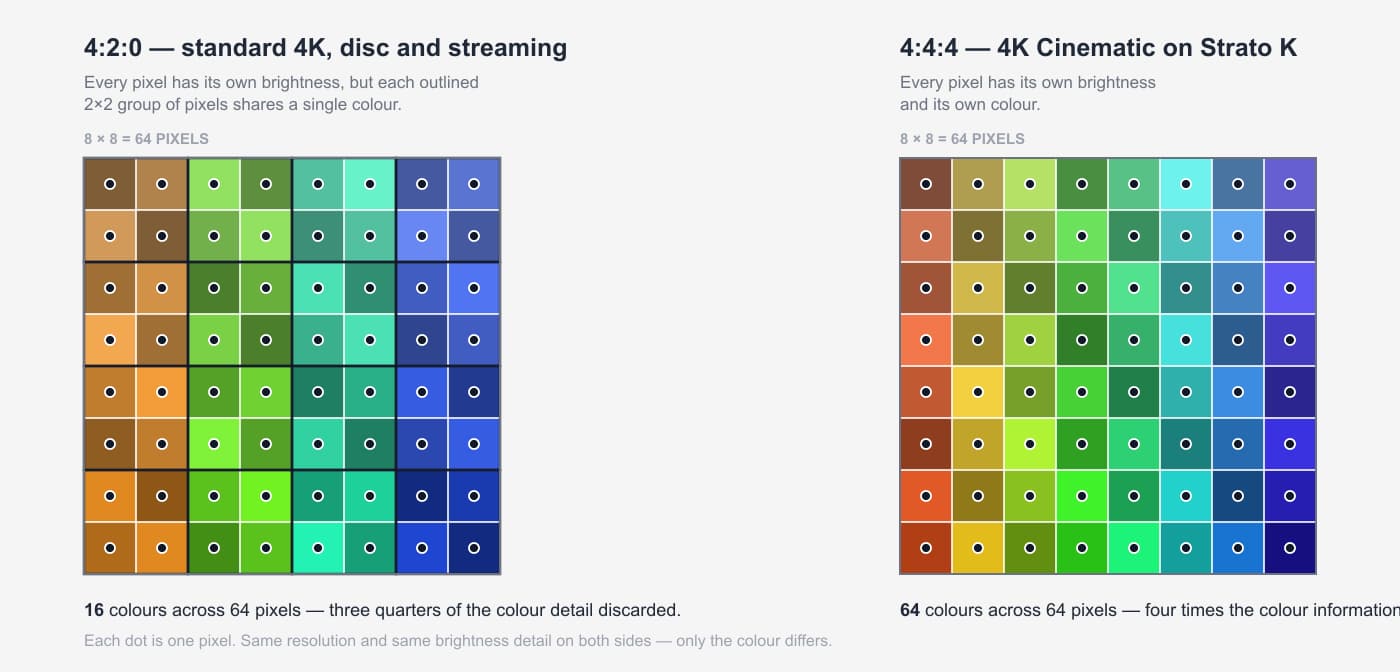
Standard 4K — on disc and from every streaming service — stores color at 4:2:0. Resolution is not reduced and brightness is still recorded for every pixel; what is shared is color, with a single color sample covering each 2x2 group of pixels. Three quarters of the color detail is discarded before the file ever reaches you.
4K Cinematic is Kaleidescape's exclusive format, carrying full chroma up to 4:4:4 at an average bitrate of roughly 110 Mbps — files about 1.5 times the size of an already-large standard Kaleidescape 4K title. That is up to four times the color information available on 4K Blu-ray or from streaming.
The practical effect: saturated reds and skin tones stop smearing at their edges, colored text and fine graphic detail stay crisp, and motion holds together where compression normally falls apart. Select titles have been re-transcoded into the format, with the catalog growing over time. The Strato K is the only player that supports it. One practical consequence worth planning for: because the files are so much larger, a server holds a little over half as many 4K Cinematic titles as standard 4K ones.
Native 8K — Strato K only
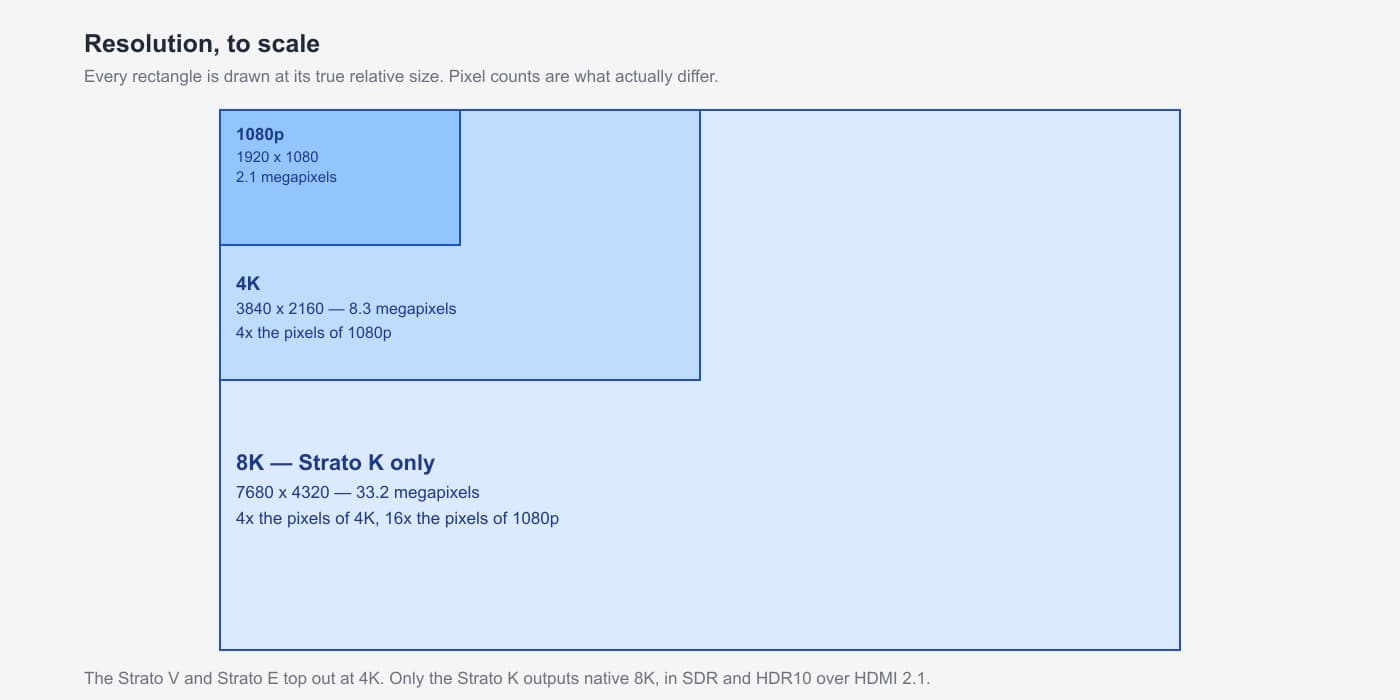
The Strato K is also the only player in the line with native 8K playback, in both SDR and HDR10, over a 24 Gbps HDMI 2.1 output. The Strato V and Strato E top out at 4K.
Between 8K support and exclusive access to 4K Cinematic, the Strato K is the player to build around if you are specifying a new system and want the highest-fidelity playback currently available in any format. We can demonstrate the difference on a properly calibrated system before you commit.
Bitrate
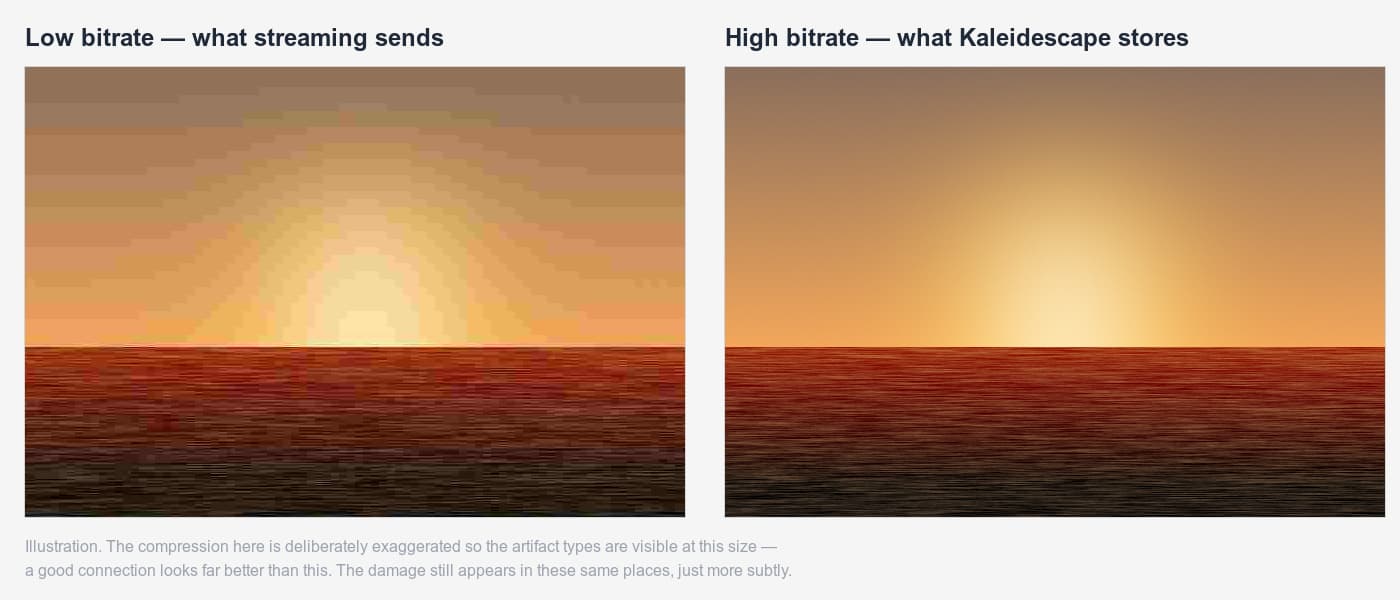
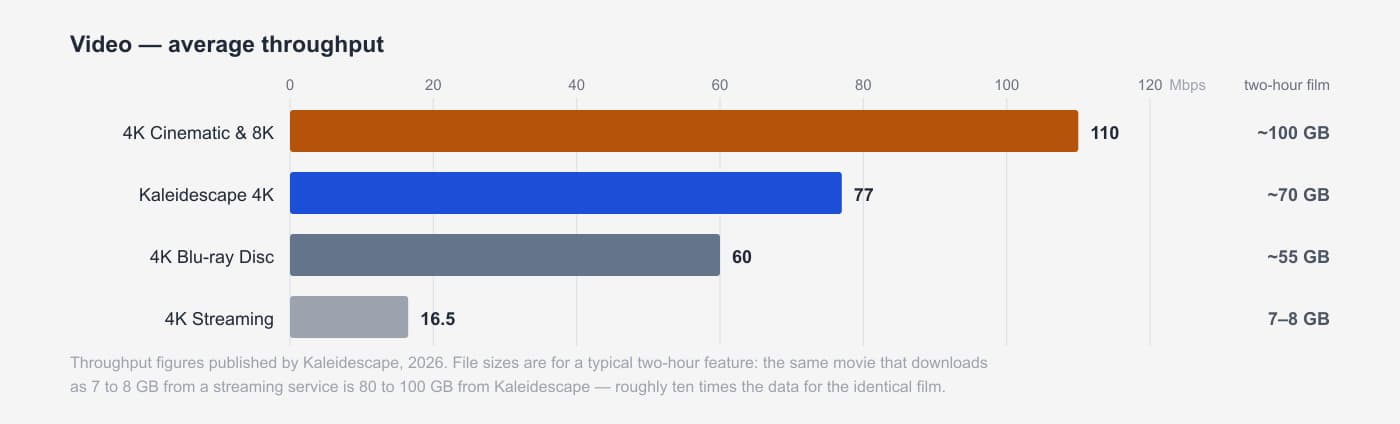
The same film that downloads as 7 or 8 GB from a streaming service is 80 to 100 GB from Kaleidescape — roughly ten times the data for the identical movie. That difference is not marketing. It is the compression a streaming service has to apply to deliver a film in real time over a connection that might fluctuate mid-scene.
Measured as throughput, Kaleidescape's published averages put a 4K title around 77 Mbps and 4K Cinematic around 110 Mbps — past the roughly 60 Mbps of a 4K Blu-ray disc, and many times what a stream sustains across a whole film.
Strato players pull up to 100 Mbps from local storage during playback. The comparison below is a synthetic illustration — the same generated image, one copy heavily compressed, one at full quality — and the compression is deliberately overdone so the artifact types are legible at this size. Real streaming on a good connection looks considerably better than that left panel. What stays true is where the damage lands: banding across smooth gradients, blocking around bright highlights, and fine texture smearing into mush. On a large calibrated projector those same artifacts are far more visible than they are on a laptop.
This is the single largest source-side upgrade available in a home theater, and you get it from any player in the line.
Lossless audio
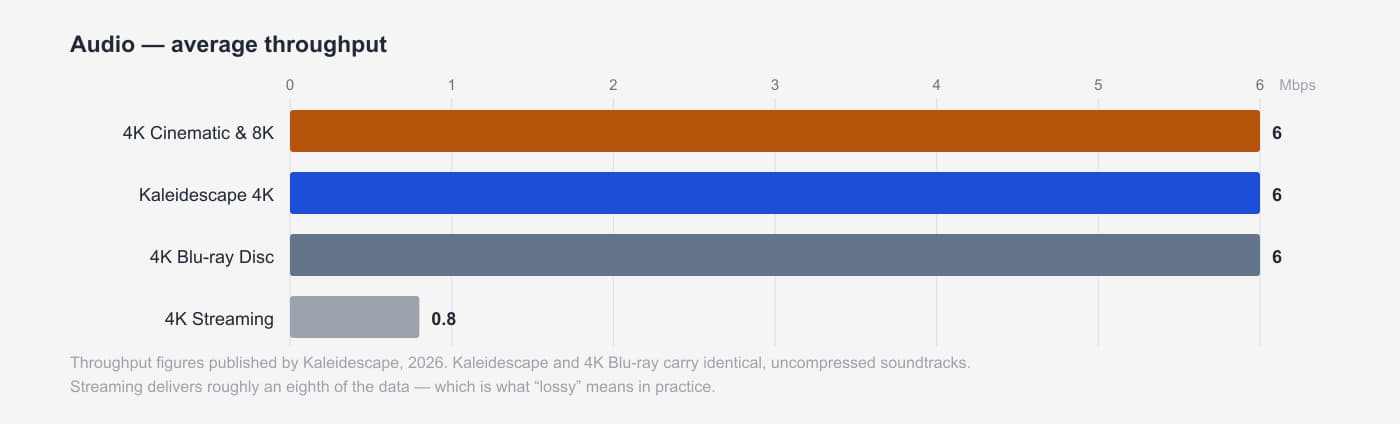
The gap is even wider on audio. Streaming delivers roughly 0.8 Mbps, even when the badge says Atmos. Kaleidescape carries about 6 Mbps — the same as a 4K Blu-ray disc — because it is not compressing the audio at all. Dolby Atmos, Dolby TrueHD, DTS:X, and DTS-HD Master Audio all pass through HDMI bit-for-bit, identical to the disc master.
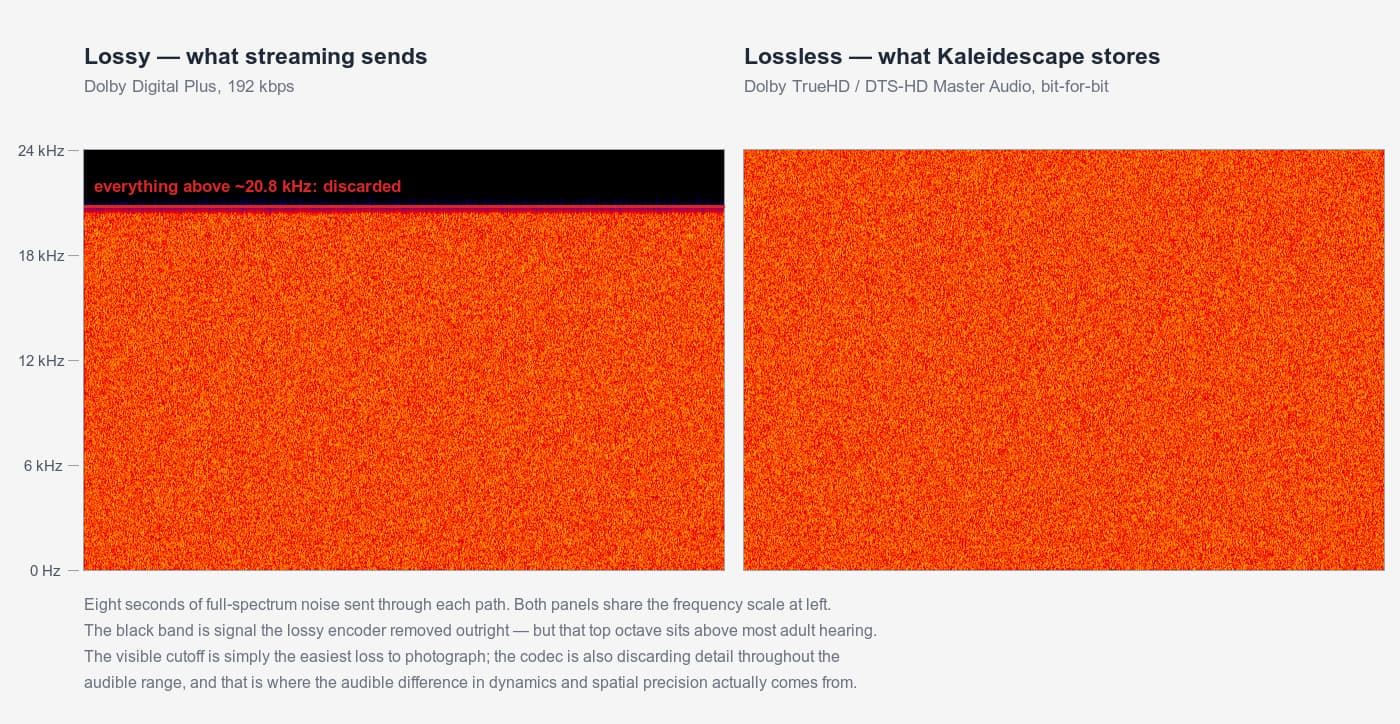
The spectrograms below show eight seconds of full-spectrum noise sent through each path — Dolby Digital Plus at 192 kbps on the left, untouched on the right. The black band is signal the lossy encoder removed outright, everything above roughly 20.8 kHz. In fairness that top octave sits above most adult hearing; the visible cutoff is simply the easiest loss to photograph. The codec is also discarding detail throughout the audible range, and that is where the difference you actually hear comes from.
In a room with a properly configured immersive layout and room correction, the audible payoff is in dynamics and spatial precision: height objects placed exactly rather than vaguely, low-end dynamic range intact, and dialogue that keeps its body.
Dynamic range — the other half of the audio story
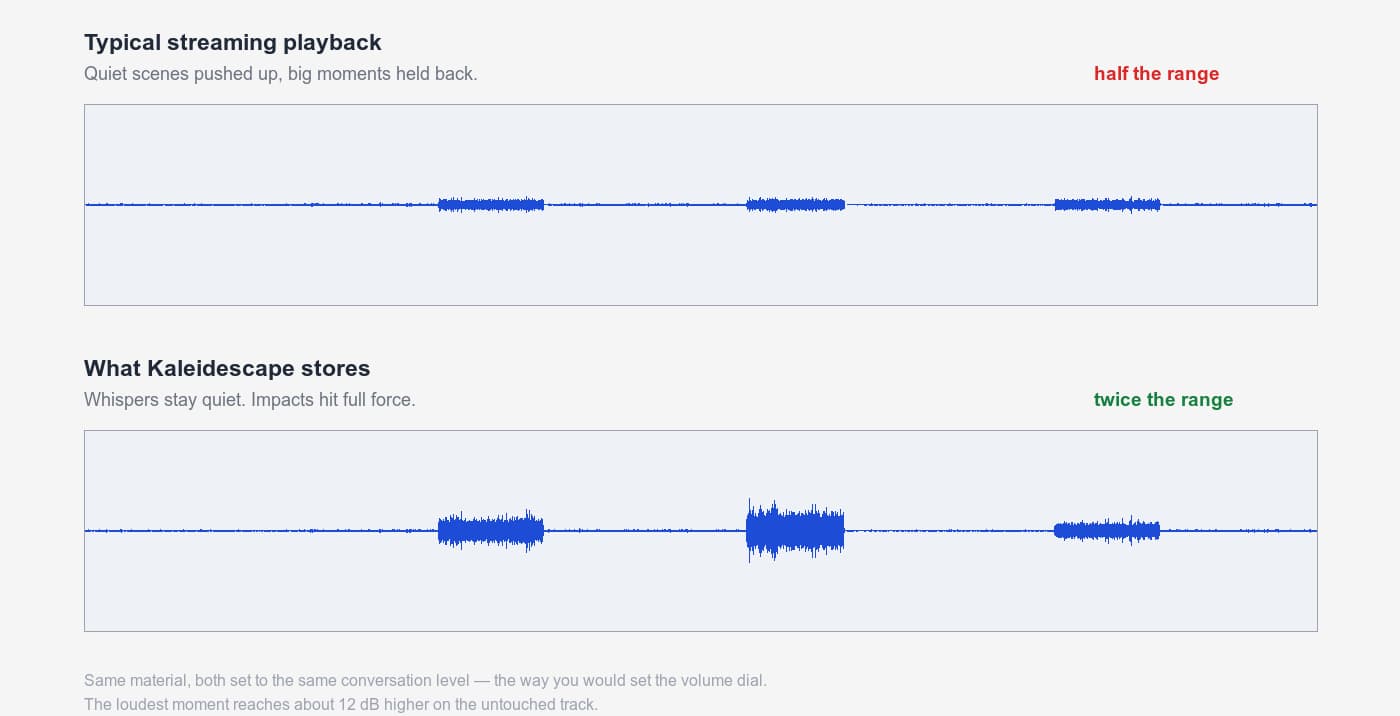
Lossy encoding and dynamic range are two separate problems, and the second one is the one you actually notice. A codec barely changes how loud or quiet a film gets. What flattens it is dynamic range control — streaming audio carries instructions to squeeze the range, and most playback devices apply them by default.
That is the top trace below: quiet scenes pushed up, big moments held back, the whole film squeezed toward the middle. Kaleidescape stores the master's own dynamics, untouched. Set both to the same conversation level and the loudest moment lands about 12 dB higher on the Kaleidescape track — roughly twice the range.
This is what people mean when a film sounds flat on a streaming box and alive in a proper theater. It is also why the difference shows up most on exactly the material a dedicated room is built for: a whispered line that stays a whisper, and an impact that startles you because the ninety seconds before it were genuinely quiet.
Local playback, not a live stream
Kaleidescape downloads titles asynchronously in the background, then plays them back from local storage. Playback quality is therefore completely independent of what your internet connection is doing at that moment.
No buffering, no mid-film quality drop when someone else in the house starts a video call, no waiting through a low-resolution opening scene while the stream ramps up. The movie starts at full quality and stays there — which is the entire point of building a dedicated theater in the first place.
Why Buy Kaleidescape Through TekScene
- Right-sized system design — Storage capacity, player count, and server choice depend on how large a library you want and how many rooms need access. We size the system to your actual collection and floor plan instead of selling you a box and leaving the math to you.
- Network and integration work done properly — Kaleidescape depends on solid networking for downloads and whole-home distribution, and on clean HDMI handoff to your processor, receiver, and display. We handle network configuration, player-to-server grouping, EDID and signal chain setup, and control system integration before we leave.
- Complete signal chain expertise — A Kaleidescape source is one part of the picture. We match it to the right projector, video processor, screen, and audio system, and calibrate the result so the fidelity you paid for actually reaches your eyes and ears.
- Local, ongoing support in Columbia, SC — We're based in Chapin and serve the Columbia metro directly. Firmware updates, adding a player to a new room, or expanding storage down the road are a phone call away, not a support ticket.
Frequently Asked Questions
What is 4K Cinematic, and do I need a specific player for it?
4K Cinematic is Kaleidescape's exclusive video format, offering full chroma up to 4:4:4 at an average bitrate around 110 Mbps — up to four times the color information available on 4K Blu-ray or from streaming. It plays only on the Strato K movie player, which is also the only player in the line with native 8K support. Select titles have been re-transcoded into 4K Cinematic and the catalog continues to grow, so if the format matters to you, the Strato K is the player to specify.
Does Kaleidescape support 8K?
Yes — the Strato K movie player supports native 8K playback in both SDR and HDR10, output over HDMI 2.1 at 24 Gbps. It is the only player in the Kaleidescape line that does; the Strato V and Strato E top out at 4K. If you own or are planning an 8K display, the Strato K is the player to specify, and it is also the only route to Kaleidescape's exclusive 4K Cinematic format.
How is Kaleidescape actually different from streaming 4K on Apple TV or Netflix?
Bitrate. A Kaleidescape movie file is typically ten times larger than the same title from a streaming service, because a streamer has to compress hard to deliver in real time over a connection that might fluctuate mid-scene. That extra data goes straight into the image: film grain stays as grain instead of turning into smeared blocks, gradients in dark scenes and skies hold without banding, shadow detail survives instead of crushing to black, and fast motion and complex scenes don't fall apart the way they do when a stream runs out of bits. The audio gain is equally real — Kaleidescape passes Dolby Atmos, Dolby TrueHD, DTS:X, and DTS-HD Master Audio through bit-for-bit, while streaming platforms deliver compressed audio even when the Atmos badge appears. On a calibrated projector and a properly configured immersive speaker layout, both differences are obvious side by side.
Bitrate and audio are the two that apply to every player, and there are four more — dynamic range, the fact that it plays a local file rather than a live stream, and on the Strato K full 4:4:4 color and native 8K. Each is set out with illustrations in why Kaleidescape beats streaming further up this page.
Do I need a Terra server, or can I start with just a player?
You can start with just a player. Strato K, Strato V, and Strato E all have internal solid-state storage and work standalone. A Terra Prime server becomes worthwhile when your library outgrows a player's internal storage, or when you want the same collection available to multiple rooms at once. Systems are designed to grow — you can add a server later without replacing the player.
Is there a subscription, or do I own the movies?
There is no subscription fee. You purchase titles outright from the Kaleidescape movie store and they are yours, downloaded to your own storage. Rentals are also available for titles you only want to watch once, and a rental can be applied toward buying the same title later. The store also offers Early Release and Premium Rental titles while they are still showing in theaters — subject to availability and which studio released them.
How much storage do I actually need?
It depends how much you want kept locally at all times. A Strato K or Strato V holds 960GB, a Strato E 480GB — a handful of titles each, and downloaded movies become eligible for automatic deletion 48 hours after playback, so a player on its own works well if you watch and move on. If you want a standing library ready to play, that is what a Terra server is for: roughly 130 4K movies on a Mini Terra Prime, about 500 on a 30TB Compact Terra, and around 2,000 on a full-size Terra Prime. Note that 8K and 4K Cinematic files are much larger, so a server holds a little over half as many of those. We size this with you rather than guessing.
What internet speed do I need?
Faster is better for downloads, but playback quality does not depend on your connection at all. Titles download asynchronously in the background and play back from local storage, so nothing buffers and nothing drops resolution mid-film. Over gigabit Ethernet a Strato K can pull a movie in as little as 15 minutes. Terra Prime adds 2.5G networking for faster downloads still.
Will it work with my existing projector, receiver, and control system?
In nearly all cases, yes. Strato players output over HDMI with lossless audio bitstreamed to your processor or receiver, and Kaleidescape integrates with the major home automation and control platforms. The details matter — EDID handling, HDMI signal chain, network configuration, and control integration all need to be set up correctly. That is the part we handle as your local dealer.
Ready to Hear What You've Been Missing?
Whether you're building a dedicated theater or upgrading the source in an existing system, we'll help you choose the right Strato and Terra combination and integrate it properly with the rest of your setup.