

Stewart Filmscreen Projection Screens
Stewart Filmscreen has been the reference standard in projection screens for over 75 years. Used in Hollywood screening rooms, post-production facilities, and the world's finest home theaters, Stewart screens are manufactured in the USA with a level of quality control that mass-market brands simply cannot match. When you invest in a premium projector, the screen you pair it with matters just as much — and Stewart is where serious home theater builders turn.
Products
Stewart manufactures over 25 screen materials in-house, each engineered for specific viewing conditions. These three are the most popular choices for dedicated home theaters. Stewart also offers GrayHawk G4, Phantom HALR Plus, Harmony G3 (acoustically transparent), and many more — contact us for guidance on the right material for your room.
Stewart offers screens for every installation scenario — from permanent fixed-frame installations to fully concealed motorized systems with auto-masking. Every screen is built to order to your exact specifications.
StudioTek 100
The reference standard. Unity gain (1.0) with Lambertian light dispersion — image brightness is virtually unchanged from any viewing angle. Used in Hollywood post-production and color grading suites. Only 2% white field uniformity variance. Requires a fully light-controlled room.
StudioTek 130 G4
The industry standard for premium home theaters. THX and ISF certified with 1.3 gain and a wide 80° half-gain angle. The fourth-generation coating eliminates the visible texture of earlier generations — reviewers describe a grainless, texture-free image above 70% white with no hot spotting. 30% brighter than matte white, making it critical for HDR content where every foot-Lambert counts.
FireHawk G5
Stewart’s flagship ambient light rejecting material. THX and ISF certified, the G5 rejects 73% of ambient light while maintaining 1.1 gain. Delivers superb black levels, excellent shadow detail, and superior color saturation in rooms where total darkness isn’t achievable. 35° half-gain angle.
Fixed Frame
Permanently mounted screens with perfectly tensioned fabric on an aircraft-grade aluminum frame. The best choice for dedicated home theaters where the screen is always visible. Multiple frame profiles and sizes available, including curved options.
About
What sets Stewart apart is their screen material science. They manufacture their own screen fabrics in-house, offering materials optimized for every scenario: reference-grade materials for light-controlled rooms, ambient light rejecting options for living spaces, acoustically transparent fabrics for behind-screen speaker placement, and motorized or fixed-frame options in virtually any size and aspect ratio. Each screen is built to order to your exact specifications.
TekScene is an authorized Stewart Filmscreen dealer serving the Columbia, SC metro area. We help you select the right screen material, size, and mounting style for your room and projector. A Stewart screen is a precision product — and it deserves precision installation. We ensure your screen is perfectly tensioned, level, and positioned for optimal image quality. We serve the greater Columbia area — Chapin, Lexington, Irmo, West Columbia, and Lake Murray.
Acoustic Transparency & Perforations
In a dedicated home theater, the ideal speaker placement is directly behind the screen — centered with the image, exactly where dialogue and effects originate on screen. Stewart offers multiple acoustic transparency options to make this possible without compromising picture quality. Stewart designs and builds their own perforation equipment in-house, allowing them to perforate screens much larger — and faster — than other manufacturers.
In a dedicated home theater, the ideal speaker placement is directly behind the screen — centered with the image, exactly where dialogue and effects originate on screen. Stewart offers multiple acoustic transparency options to make this possible without compromising picture quality. Stewart designs and builds their own perforation equipment in-house, allowing them to perforate screens much larger — and faster — than other manufacturers.
Perforation Options for Home Theater
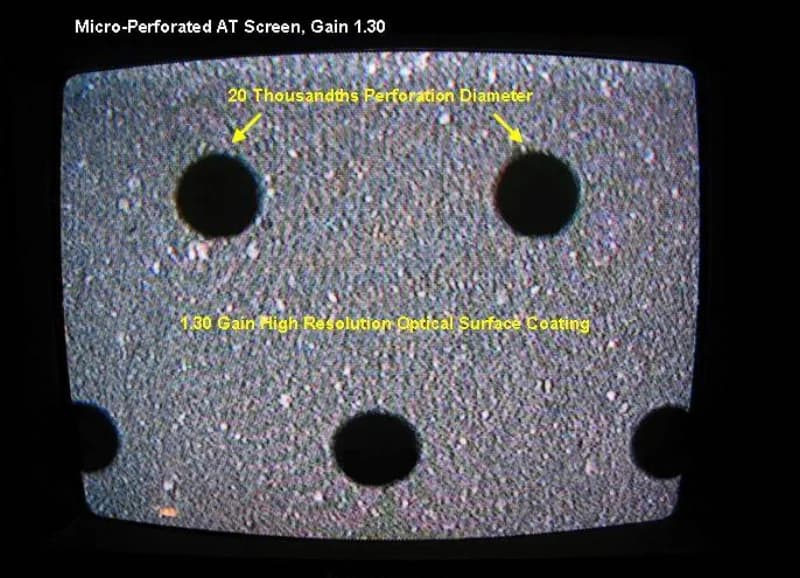
Stewart uses proprietary diamond-shaped perforation patterns designed to minimize moiré. Both options can be applied to Stewart's front projection materials including StudioTek 130 G4 and FireHawk G5.
UltraPerf — Stewart's newest and smallest perforation, the most popular choice for home theaters. Designed for screens up to 7 feet tall, UltraPerf holes are 12% smaller than MicroPerf X2 and account for just 8.9% of the screen area, making them the least visible option. Viewers can sit 1.5 to 2 feet closer before perforations become apparent. On a StudioTek 130 G4 screen, UltraPerf maintains an effective gain of ~1.21 — roughly 40% brighter than woven acoustically transparent alternatives, a significant advantage for HDR content.
MicroPerf X2 THX Ultra — Over 30,000 perforations per square foot with 10.2% open area, awarded THX Ultra certification. Recommended for larger home theaters and medium-sized venues where screens exceed 7 feet tall. Perforations are invisible from 12 feet away.
Speaker Placement Behind Perforated Screens
Speakers should be placed at least 12 inches behind a perforated Stewart screen for optimal audio performance. Wide-dispersion horn tweeters can be placed as close as 5–6 inches. UltraPerf requires only a modest 1 dB EQ boost above 3,000 Hz and about 3 dB above 7,000 Hz. An optional black scrim can be draped over the backs of the speakers (not between speaker and screen) to prevent light leakage through the perforations without affecting audio quality.
Harmony G3 (Woven Acoustic)
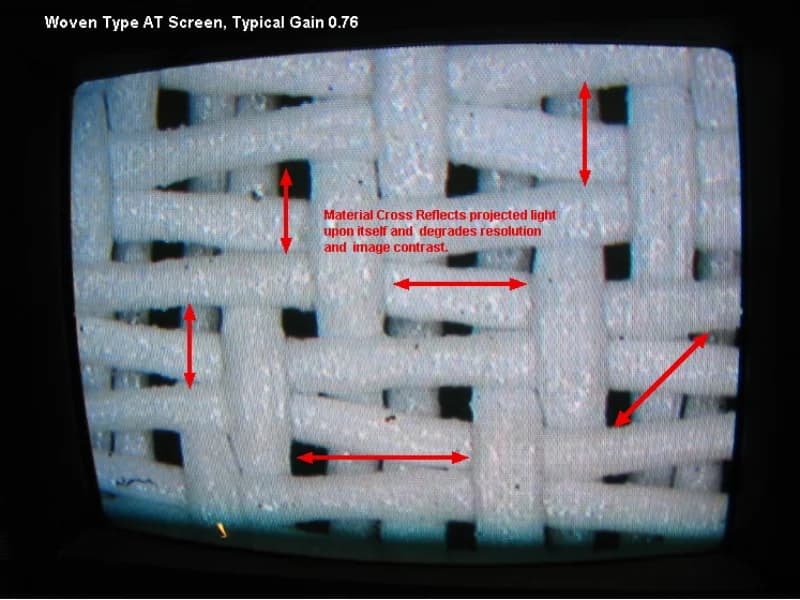
A fundamentally different approach: Harmony G3 is a woven material that is inherently acoustically transparent, rather than perforated. With a 0.7 gain Lambertian surface, it provides neutral 4K/8K+ resolution with no color distortion. Speakers can be placed as close as 1 inch behind the screen. The trade-off is lower brightness — woven screens measure around 40% dimmer than a perforated StudioTek 130 G4, which limits HDR performance.
Avoiding Moiré with Perforated Screens
When a fixed pixel grid from a digital projector aligns with a fixed perforation pattern, moiré interference can appear as visible banding. Stewart solves this with their diamond-shaped pattern orientation, which can be rotated up to 26° relative to the screen edges based on image width and the projector's pixel fill ratio. For screens 123″ diagonal and above, no rotation correction is typically needed. This is why working with an experienced integrator matters — we work with Stewart to match the perforation pattern to your specific projector before the screen is manufactured.
Stewart offers screens for every installation scenario — from permanent fixed-frame installations to fully concealed motorized systems with auto-masking. Every screen is built to order to your exact specifications.
Screen Types
Stewart offers screens for every installation scenario — from permanent fixed-frame installations to fully concealed motorized systems with auto-masking. Every screen is built to order to your exact specifications.
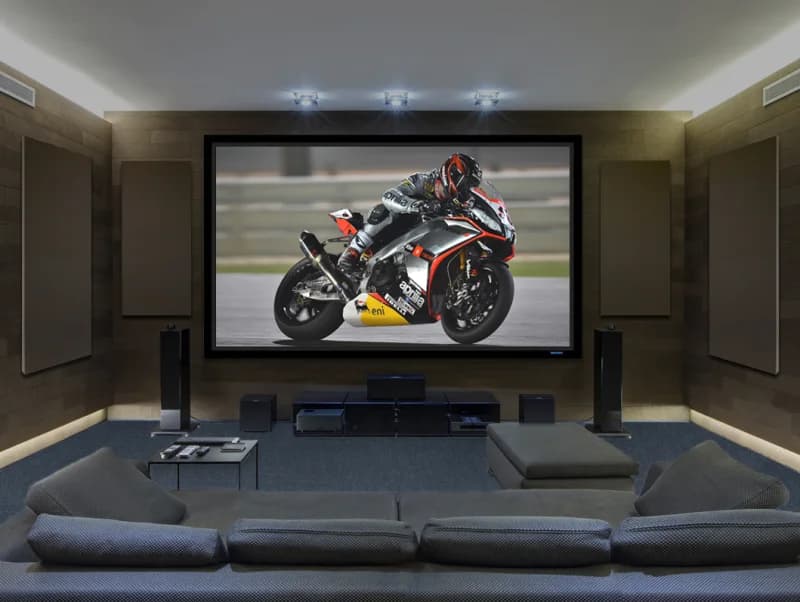
Fixed Frame
Permanently mounted screens with perfectly tensioned fabric on an aircraft-grade aluminum frame. The best choice for dedicated home theaters where the screen is always visible. Multiple frame profiles and sizes available, including curved options.
WallScreen Series • Balon Series • CineCurve • Cima FF
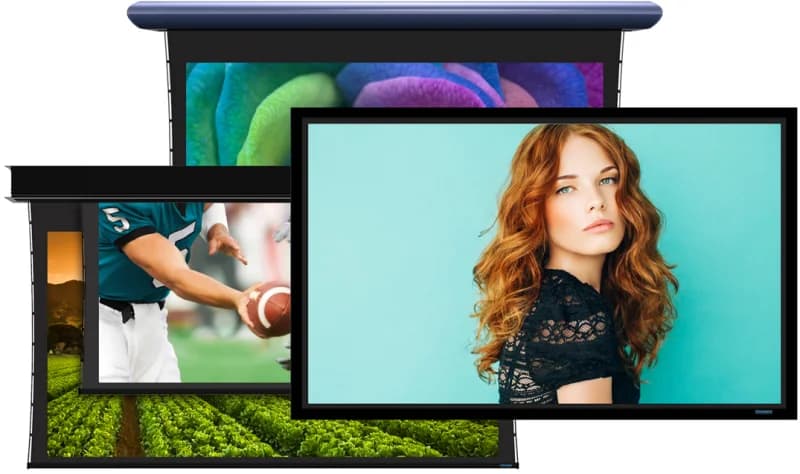
Retractable / Motorized
Screens that deploy from concealed ceiling housings, exposed below-ceiling cases, or even from the floor. Ideal for multi-purpose rooms where the screen disappears when not in use. Options range from quiet trapdoor systems to designer-finished enclosures.
Stealth • Cascade • Luxus • Cabaret • Gemini • AllRise
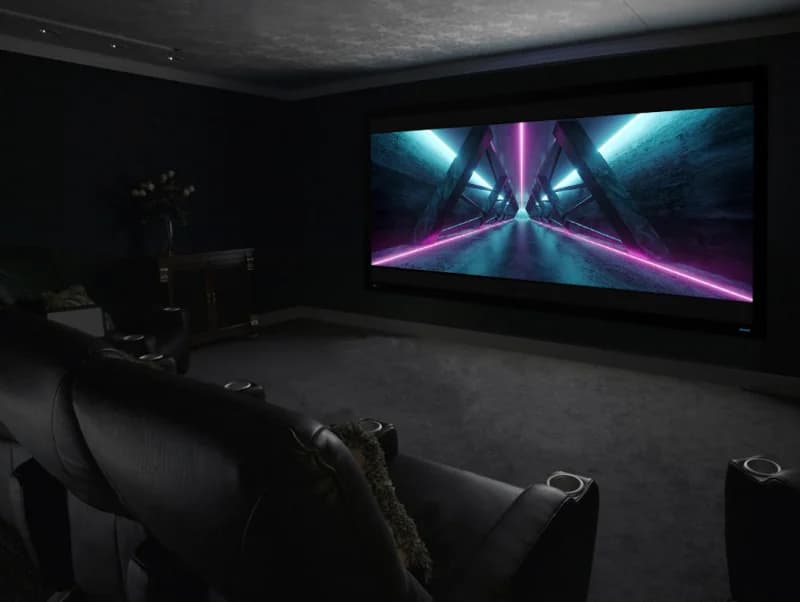
Auto-Masking
Fixed-frame screens with motorized masking panels that adjust to any aspect ratio automatically. Black velvet masking eliminates gray bars and enhances perceived contrast. The Director's Choice offers four-way continuous variable masking for the ultimate cinema presentation.
Director's Choice • VistaScope • WallMask • CineCurve Cine-V
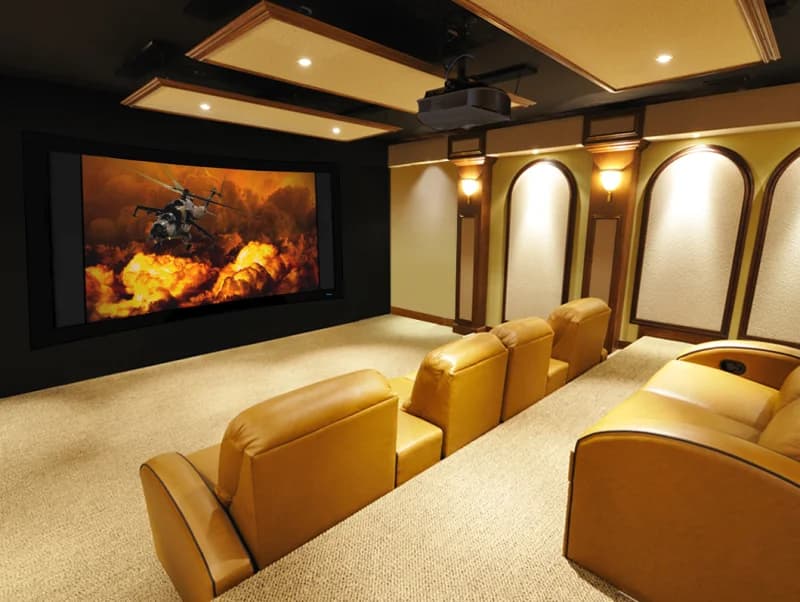
Curved & Specialty
Curved screens optimized for anamorphic lenses deliver true cinema immersion with edge-to-edge focus uniformity. Stewart also builds custom immersive environments, simulator screens, and specialty optical coatings for unique applications.
CineCurve • Custom & Immersive • Specialty Coatings
Why Buy Stewart Filmscreen Through TekScene
- Screen material expertise — Choosing the right Stewart material is critical. We assess your projector’s output, your room’s light conditions, whether you need acoustic transparency for behind-screen speakers, and your viewing preferences to recommend the optimal fabric.
- Precision installation — A Stewart screen is a premium product that demands professional installation. We ensure perfect tension, level mounting, and precise alignment with your projector for a flawless image from edge to edge.
- Complete projection system design — We design the full system around your Stewart screen — projector selection, throw distance calculation, lens shift optimization, and masking configuration for the ultimate projection experience.
- Authorized dealer, local support — Full manufacturer warranty through an authorized channel. Based in Chapin, SC, we’re available for installation, maintenance, and any adjustments your screen needs over time.
Frequently Asked Questions
How do I choose a screen material?
The decision is driven by the light in the room, and we walk through it in full under how to choose a screen material.
What is specific to Stewart is the reference end of it. StudioTek 100 is unity gain — it returns light without adding or removing brightness, an optimal diffuser built to the strictest color and white-field uniformity standards. StudioTek 130 G4 does the same job about thirty percent brighter, at a peak gain of 1.3, and is THX certified. Between them they are the materials professional screening rooms specify when the screen must not be the variable.
Gain above unity is not a free upgrade — push it far enough and you buy brightness with viewing angle and uniformity. What makes 1.3 the one most rooms land on is that it is barely above neutral: bright enough to matter on a large screen or with a projector working hard, without the hotspotting that higher-gain materials trade away. In a room you can make properly dark, that neutrality is the entire point — nothing is being done to the image that has to be undone later.
What do THX and ISF certification on a screen actually mean?
That the material has been measured against a standard for color neutrality and uniformity, and behaves predictably.
A screen is part of the optical chain, not a passive white wall. A material that shifts color, or reflects unevenly across its surface, moves the picture away from what the projector is sending — and any calibration then has to work around it. A certified material means the screen is not the variable.
In practice this matters most in a room where the picture is going to be calibrated, or where you care that the image at the edges matches the image at the center. It matters less in a casual room, though it does no harm there either.
Fixed frame, retractable, or masking?
Fixed frame if the room can spare the wall, and in a dedicated theater it usually can.
A fixed screen is permanently tensioned on its frame, so it is flat, stays flat, and has no mechanism to fail. Retractable makes sense in a room with another life, where the screen should disappear when it is not in use — modern tensioned designs are far flatter than the roll-up screens people remember.
Masking is a different question and worth understanding separately. Films arrive in different shapes, and on a fixed screen the ones that do not match leave black bars. Masking moves panels to frame each shape properly, so a scope film fills the screen and a 16:9 one is framed to its edges. In a serious room it makes more difference to how a film looks than most single upgrades, because it removes the gray non-picture area from the edge of your vision.
Curved screens serve a narrower purpose again, mostly with anamorphic setups on very wide screens.
Do I need a perforated or woven screen?
Only if you want the speakers behind it, which in a dedicated theater is worth wanting.
Putting the front three speakers behind the screen puts dialogue where the actor's mouth is, rather than above or below the picture, and frees the whole wall for the image. In a purpose-built room that is the arrangement to aim at.
The historic objection to perforated screens is that you can see the holes if you sit close enough, which pushed people toward woven materials or toward sitting further back than the room wanted. Stewart's UltraPerf is the answer to that: the holes are around twelve percent smaller than the previous perforation, so the seating distance at which they disappear comes in closer — and it holds gain better than a larger perforation does, which is what makes a high-gain acoustically transparent screen viable rather than a compromise.
That combination is why our own demo theater in Chapin is StudioTek 130 G4 with UltraPerf. It is the material we would specify for a reference room, so it is the one we put in ours.
There is a detailed treatment of perforation options, speaker placement behind the screen and avoiding moiré further up this page.
What size screen should I get?
Work back from where people sit, and on an acoustically transparent screen let the material have a say in how close that can be.
What decides whether a picture feels right is the angle it fills in your vision, which depends on size and seating distance together — our screen size comparator does that arithmetic and shows the standards side by side. On a perforated screen there is a second limit underneath it: the distance at which the perforation stops being invisible. That is the limit UltraPerf moves, and moving it is what lets a room seat people close to a large screen without the texture showing.
Then the room imposes the rest — ceiling height, where the projector can go and what it can throw, speaker positions behind the screen, and whether a scope shape suits what you watch. Because a Stewart is built to the size and material you order, those answers want settling before anything is made rather than after.
Should I choose Stewart Filmscreen or Screen Innovations?
We carry both and have no reason to push you either way, so the honest answer is that it depends on the room rather than the badge.
Both make excellent materials and both manufacture their own fabrics. Where they differ is emphasis. Stewart's reputation comes from reference-grade material science and certified, industry-standard materials — the ones used in professional screening rooms, where the screen must not be the variable. Screen Innovations built its reputation on ambient light rejection and on mounting formats suited to rooms doing more than one job.
In a dedicated, fully light-controlled theater that tends to favor one; in a bright or multi-purpose room, the other. But the overlap is real and both have answers in both directions.
See the Screen Innovations range for the equivalent materials.
Do you install the screen?
Yes, and with Stewart the specifying matters as much as the hanging.
These are built to order — size, aspect ratio, material, perforation, frame and any masking are chosen before the screen exists. That is what lets a screen fit a room exactly, and it is also why the decisions are worth getting right the first time: a made-to-spec screen is not something you swap because the throw distance turned out differently.
So the work starts before the order. Projector and throw, seating distance against the perforation, where the speakers sit behind it, how much wall there actually is once the frame is accounted for. We handle that specification and the installation together as part of the system, and configuration and optimization come with it.
Interested in Stewart Filmscreen? Let’s Talk About Your Project.
From a fixed-frame reference screen to a motorized masking system, we’ll help you specify and install the perfect Stewart screen for your theater.
More from TekScene
Related Brands