

TCL Televisions
Mini LED picture quality at sizes and prices that make a big screen realistic.
Products
QM7L Series
The entry point into the SQD-Mini LED line, in 55 to 98 inches. Super Quantum Dot color and a Mini LED backlight in the sizes most living rooms actually take — the model to look at first if the room has daylight and the budget is real.
QM8L Series
The step up, 65 to 98 inches, built around the WHVA 2.0 Ultra panel with over 4,000 local dimming zones and peak brightness TCL rates up to 6,000 nits. The zone count is what buys clean highlights against dark backgrounds rather than a gray halo around them.
X11L Series
TCL's flagship SQD-Mini LED, 75 to 98 inches. The most capable expression of the Super Quantum Dot line — for a dedicated room, or a large open space where the television has to hold up against windows on two sides.
RM9L Series
A different backlight altogether: RGB Mini LED, where the LEDs themselves produce red, green and blue rather than filtering white light through quantum dots. Available at 85 to 115 inches — the largest panel TCL makes, and an alternative to a projector in a room that cannot be darkened.
About
TCL has spent the last few years doing something the television market did not expect: putting genuinely good Mini LED backlights, wide color and very large panels within reach of normal budgets. The result is that an 85-inch television with thousands of dimming zones is now a reasonable thing to put in a family room, rather than a flagship purchase.
The current SQD-Mini LED line is where that shows most clearly. Super Quantum Dot emitters widen the color gamut — TCL claims coverage up to 100% of BT.2020 — while the Mini LED backlight drives brightness and contrast well past what a conventional LED television manages. For rooms with real daylight in them, that combination matters more than any other specification on the box.
TekScene supplies and installs TCL televisions across the Columbia, SC area — Chapin, Lexington, Irmo, West Columbia, and Lake Murray — as part of a full system or on their own. We will tell you honestly where a TCL is the right answer and where a projector or a different panel would serve the room better.
What Dimming Zones Actually Buy You
Zone count is the specification that most affects how a Mini LED television looks, and the one hardest to picture from a number. Here is what it means in practice.
Blooming — the artifact zone count controls
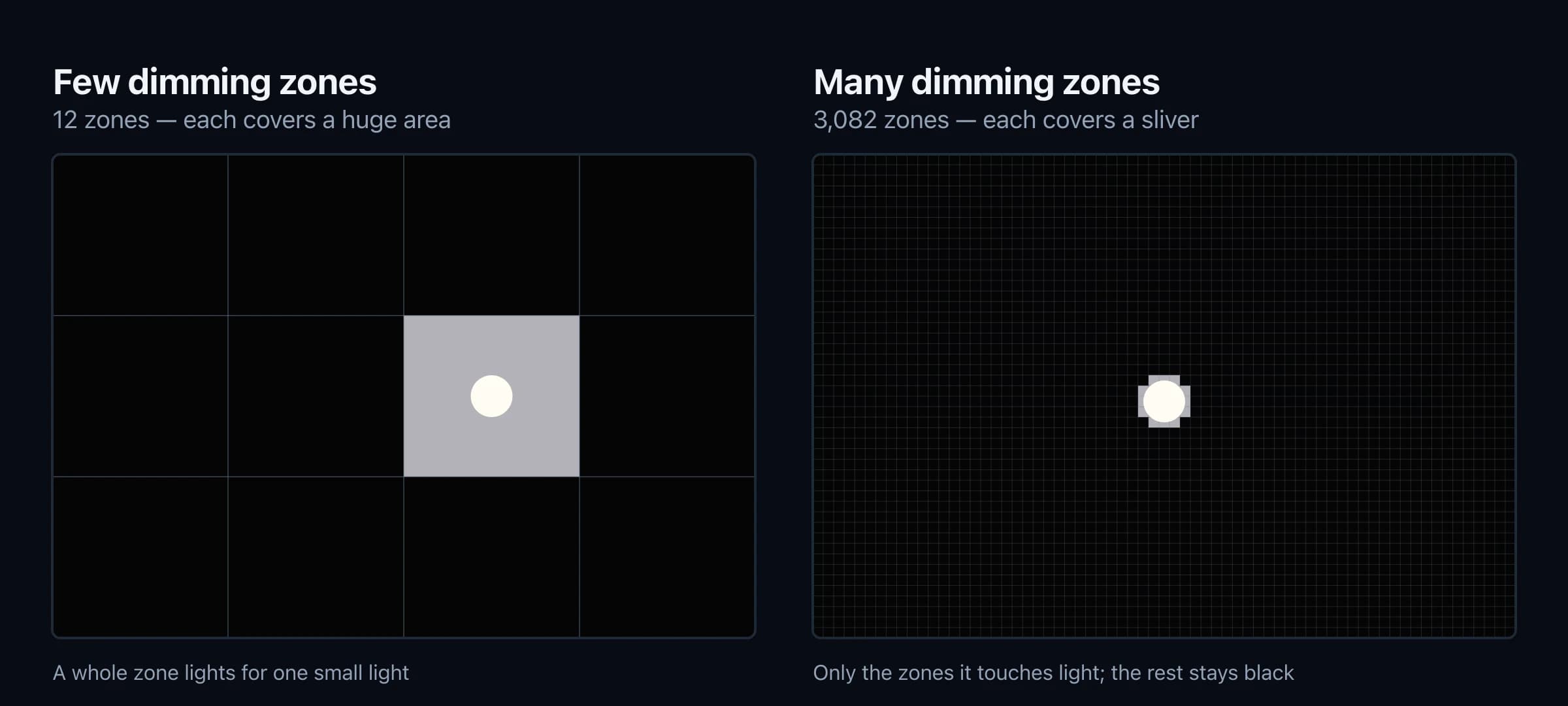
A Mini LED television lights its panel from behind with thousands of small LEDs, grouped into zones. A zone can only be one brightness at a time — so if any part of it contains something bright, the whole zone has to light up.
That is where blooming comes from. With a coarse grid, one small bright object forces a large area to turn on, and the black around it lifts to gray. With a fine grid, only the zones directly behind the object light, and the rest of the picture stays black.
It shows most on high-contrast content in a dark room — starfields, end credits, a lamp in a night scene, letterbox bars on a scope film. In a bright living room watching daytime television you would struggle to see the difference at all, which is why the right zone count depends on the room rather than on the spec sheet.
Why Buy TCL Through TekScene
- The right model for the room, not the top of the range — brightness is what fights a bright room, while zone count is what shows in a dark one, since blooming is only visible against blacks that are genuinely black. They pull in opposite directions, so which one you are buying depends on your light, your seating distance and what you watch.
- Mounted properly, and safely — large panels are heavy and awkward, and above-fireplace mounting in particular needs the wall assessed before anything is committed to. We handle the mount, the routing and the cable management.
- Set up rather than switched on — configuration and optimization are included with every installation: picture modes set for the room, HDR handled correctly, and the sources negotiating the right signal instead of whatever the handshake defaulted to.
- Local support in the Midlands — based in Chapin, SC. When something changes — a new source, a firmware update, a room that has been repainted — we are a call away rather than a support queue.
Frequently Asked Questions
Is TCL actually good, or just cheap?
Both, and the second does not undo the first. TCL competes on price by manufacturing its own panels and backlights at scale, not by cutting the things that determine picture quality.
What you get for the money is genuinely strong: Mini LED backlights with thousands of dimming zones and very high peak brightness at sizes where the established brands charge considerably more. In a bright room those two specifications matter more than almost anything else, and TCL delivers them at screen sizes that would otherwise be out of reach.
Where the premium brands still tend to lead is in processing polish — motion handling, upscaling of poor sources, and the last few percent of picture accuracy out of the box. Whether that gap is worth the price difference depends on what you watch and how much of it is high quality to begin with.
What is SQD-Mini LED, and how is it different from QD-Mini LED?
Both are Mini LED backlights paired with quantum dots. The quantum dots are what convert the backlight's blue light into pure red and green, which is where a modern television's color comes from.
SQD stands for Super Quantum Dot — a reformulated emitter that widens the color gamut further. TCL claims coverage up to 100% of BT.2020, which is the widest standard used in video mastering and one no consumer display fully reaches in practice.
The practical difference is in saturated color: deep reds and greens hold their intensity instead of washing toward orange or yellow at high brightness. It is a real improvement, though a smaller one than the jump from conventional LED to Mini LED in the first place.
What do dimming zones actually do?
They decide how precisely the backlight can be dark in one part of the picture and bright in another.
A Mini LED television lights its panel from behind with thousands of tiny LEDs grouped into zones. More zones means the bright areas can be smaller and more precisely placed — so a streetlight against a night sky stays a streetlight rather than sitting inside a faint gray rectangle. That artifact is called blooming, and zone count is the main thing that controls it — there is a side-by-side illustration of it above.
It matters most with high-contrast content in a dark room: starfields, credits, letterboxed film. In a bright living room watching daytime television, you would struggle to see the difference between a few hundred zones and a few thousand.
Should I get a large TV or a projector?
Light in the room decides it more than anything else.
A television is far brighter than any projector and holds a good picture with the curtains open, which is why it wins in a living room, a kitchen or anywhere with windows. A projector goes much larger for the money and gives a more cinematic image — but it needs the light controlled to look its best, and in a room you cannot darken it will disappoint at any price.
Size is the other axis. Televisions now reach 98 and even 115 inches, which was projector-only territory a few years ago, though the cost climbs steeply at the top. Past that, projection is still the only sensible route.
If you are weighing the two, our screen size comparator shows what each option gives you from where you actually sit, and the projector and screen page covers the other side of the decision.
Which TCL should I choose?
Start with the room's light, then the size, then the model.
A bright room rewards brightness and zone count, which pushes you up the range. A dark or well-controlled room needs much less of both, and the money is often better spent on a larger screen or on the sound. Seating distance sets the size — sitting close to a large panel is not the same as sitting far from it, and the screen size comparator does that arithmetic.
The honest version is that the top of the range is not automatically the right answer. Tell us the room, where the seating goes and what you watch, and we will point at one or two models rather than the whole lineup.
Can you mount a TV above a fireplace?
Often, but it is worth a conversation before it is worth a bracket.
Two things need checking. The first is the wall itself — masonry, framing and what is behind the finish all change how the mount is fixed, and a large panel on an inadequate fixing is a genuine hazard. The second is heat: a working fireplace can put more of it at the mount height than a television is rated for.
The third issue is comfort rather than safety. Above a mantel is usually higher than the ideal viewing height, which means looking up for the length of a film. A pull-down or articulating mount can bring the screen down and forward, and for many rooms that is the difference between a television people use and one they tolerate.
We have done a number of these — there are examples in our recent projects.
Do you set the picture up, or just install it?
Configuration and optimization are included with every installation. That means picture modes chosen for your room rather than the showroom, HDR behaving properly, motion settings dealt with, and the source devices negotiating the signal they should be rather than whatever the handshake landed on.
Out of the box, most televisions ship in a mode designed to look striking under retail lighting — over-bright, over-saturated, with motion smoothing on. Turning that off and setting it up for the actual room is the single biggest improvement most sets ever get, and it costs nothing but knowing where the settings are.
Full instrumented calibration — measured with reference equipment — is a separate service, priced by scope. On a television in a normal living room it is rarely the right spend; we will say so if that is the case.
Thinking about a new television?
Tell us the room, where the seating goes and how much light you are dealing with, and we will tell you which model actually fits — and whether a projector would serve you better.